Roof Dryer Vent Cleaning: How Often & What to Know
If your dryer vent exits through the roof instead of an exterior wall, it's easy to forget it's there.
You probably don't see the termination regularly. You may not know how much airflow is coming out of it. And unlike a wall vent that's only a few feet from the dryer, a roof vent can be part of a longer, more complicated exhaust route.
That doesn't mean a roof dryer vent is automatically a problem.
But it does mean keeping the exhaust path clear is important—and recognizing a restriction may be more difficult.
Here's what homeowners should know about cleaning and maintaining a dryer vent that terminates on the roof.
Why Do Some Dryer Vents Go Through the Roof?
A dryer's exhaust needs a route to the exterior of the building.
When the laundry room is close to an exterior wall, that route may be relatively short and straightforward.
But dryers are also installed in:
- Interior laundry rooms
- Second-floor laundry areas
- Closets
- Condos and townhomes
- Other locations far from an exterior wall
Depending on the building layout, the practical exterior termination may be through the roof.
The important thing isn't simply whether the vent terminates through a wall or roof.
It's whether the entire exhaust system is properly configured, unobstructed and able to move air outside.
Do Roof Dryer Vents Need to Be Cleaned?
Yes.
Lint gets past the lint screen and can accumulate inside the dryer exhaust system regardless of where that system terminates.
The U.S. Consumer Product Safety Commission recommends periodically cleaning the dryer vent and exhaust duct and checking the exterior vent while the dryer is operating to make sure exhaust air is escaping.
The U.S. Fire Administration recommends cleaning dryer vent ductwork every year.
A roof termination doesn't eliminate that maintenance requirement.
In some homes, it simply makes inspection and cleaning more difficult.
How Often Should a Roof Dryer Vent Be Cleaned?
A useful starting point is to inspect and clean the dryer exhaust system at least annually.
But don't treat one year as a guarantee that every vent will remain clear for exactly that long.
How quickly lint accumulates can vary based on factors such as:
- How frequently the dryer is used
- The length of the exhaust run
- The number of bends
- The condition and configuration of the duct
- The type of laundry being dried
- Whether airflow is already restricted
- The condition of the exterior termination
A household doing several loads every day may create different conditions from someone using the dryer once or twice a week.
The dryer's performance matters too.
If you're seeing signs of restricted airflow before your normal cleaning interval, don't wait for the calendar.
Why Can Roof Dryer Vents Be More Difficult to Maintain?
The biggest difference is accessibility.
A wall termination may be visible from the ground. You can often see whether its flap opens while the dryer runs and notice obvious lint accumulation.
A roof termination may be completely out of sight.
That creates several practical problems.
You May Not Notice Reduced Airflow
If you never see the exterior termination, you may not realize that airflow has become weak.
The Exhaust Route May Be Longer
A dryer located far from an exterior wall may require a longer duct run to reach the roof.
Longer runs and changes in direction can make maintenance more challenging.
The Termination Is Harder to Inspect
You can't simply walk outside and examine a roof vent the way you can many wall vents.
DIY Cleaning May Require Roof Access
Even if you're comfortable cleaning the duct from inside the house, inspecting or cleaning the exterior termination may involve working on the roof.
That introduces a completely separate safety concern.
Signs Your Roof Dryer Vent May Be Clogged
You don't necessarily have to see the roof termination to recognize a potential airflow problem.
Watch for changes in how the dryer operates.
Clothes Take Longer to Dry
This is one of the most useful warning signs.
If a load that previously dried in one cycle suddenly requires significantly more time, restricted exhaust airflow is one possible cause.
Clothes Are Still Damp After a Normal Cycle
A dryer needs airflow to carry moisture away from the clothing.
If that airflow is restricted, drying performance can suffer.
The Dryer or Laundry Area Gets Unusually Hot
Restricted airflow can cause excessive heat buildup.
CPSC specifically identifies longer-than-normal drying times as a possible indication that the lint screen or exhaust duct is blocked.
The Dryer Shuts Off During a Cycle
Some dryers have protective systems that may interrupt operation when temperatures become excessive.
A shutdown doesn't prove that the vent is clogged, but repeated overheating or shutdowns deserve investigation.
You Notice a Burning Smell
Stop using the dryer if you smell something burning and determine the source before operating it again.
Don't assume a burning smell is “just lint.”
Electrical and mechanical problems can also create unusual odors and require appropriate service.
Why Restricted Dryer Airflow Matters
A clothes dryer is designed to move warm, moisture-laden air out of the appliance and through the exhaust system.
When lint or another obstruction restricts that path, airflow decreases.
That can:
- Increase drying time
- Leave clothing damp
- Allow excessive heat to build up
- Put additional thermal stress on the dryer
- Contribute to unsafe lint accumulation
Lint is combustible.
The U.S. Fire Administration reports that failure to clean was the leading factor contributing to ignition in 31% of home clothes-dryer fires from 2018–2020.
That's why dryer-vent cleaning is more than a cosmetic maintenance task.
[READ: HOW TO PREVENT A DRYER FIRE →]
Can a Roof Dryer Vent Get Blocked at the Roof?
Yes.
The duct itself isn't the only part of the exhaust system that matters.
The exterior termination also needs to allow exhaust air to escape.
Potential problems can include:
- Lint accumulation
- Debris
- A damaged or obstructed termination
- Bird or animal nesting
- Snow or other exterior obstruction
The U.S. Fire Administration recommends keeping dryer vents clear of snow and other debris.
If the duct has been cleaned but airflow remains poor, the exterior termination is one of the areas that may need inspection.
Should a Dryer Roof Vent Have a Screen?
A dryer exhaust termination shouldn't use a screen that can collect lint and restrict airflow.
Lint needs to be able to leave the exhaust system.
A screen may look useful for keeping pests out, but it can also create another place for lint to accumulate.
If you're unsure whether your roof termination is appropriate for a clothes dryer, have the installation evaluated rather than modifying it blindly.
Can You Clean a Roof Dryer Vent Yourself?
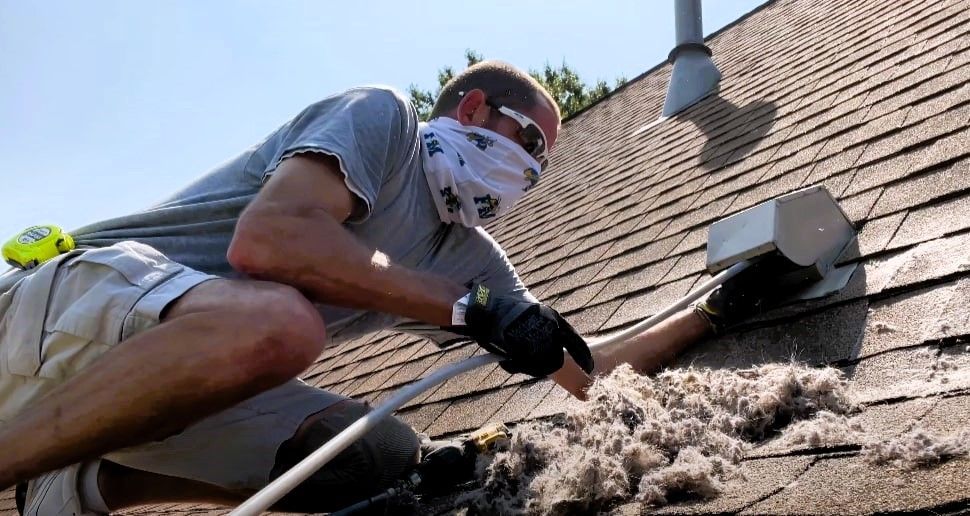
Sometimes—but roof-terminated systems can make DIY cleaning substantially more difficult.
For an accessible wall-terminated system, a homeowner may be able to disconnect the dryer, clean the exhaust duct and confirm airflow at the exterior termination without much difficulty.
A roof termination changes the equation.
You may be able to clean part or all of the duct from inside, but confirming that the exterior termination is clear may require roof access.
Don't climb onto a roof simply to save the cost of professional dryer-vent cleaning if you aren't equipped and experienced to work there safely.
Falls are a much bigger hazard than a dirty dryer vent.
If the system can be completely and safely serviced from inside, DIY cleaning may still be possible.
[READ: HOW TO CLEAN A DRYER VENT →]
How Is a Roof Dryer Vent Professionally Cleaned?
The goal is the same as with other dryer-vent systems:
Remove accumulated lint and obstructions so exhaust air has a clear path to the outdoors.
The exact cleaning method depends on the system.
We use a reverse-air hose with high-powered compressed air to move lint through dryer vents.
For stubborn or moist lint buildup, a spin brush can also be used when appropriate.
The configuration of the vent determines how the system is approached.
A short wall termination and a longer roof-terminated vent aren't necessarily going to require exactly the same amount of time or work.
Do Roof Dryer Vents Take Longer to Clean?
They can.
Many straightforward dryer-vent cleanings take approximately 30 minutes, but roof-terminated vents may be more complicated depending on:
- Vent length
- Number of bends
- Accessibility
- Amount of lint accumulation
- Whether the exterior termination needs attention
- Whether the duct contains a significant blockage
That's why we wouldn't promise that every roof dryer vent can be cleaned in a specific amount of time.
What If the Dryer Vent Keeps Clogging?
Repeated heavy lint accumulation deserves investigation.
Cleaning removes the accumulated lint, but it doesn't change the physical design of the exhaust system.
If a vent repeatedly becomes restricted unusually quickly, factors worth evaluating include:
- An excessively complicated exhaust route
- Numerous bends
- Crushed or damaged ductwork
- Improper duct material
- A problem at the exterior termination
- Another airflow restriction
The dryer manufacturer's installation instructions are important because allowable exhaust configurations vary by appliance.
If the underlying problem is the vent's design or condition, repeatedly cleaning it doesn't correct that problem.
Roof Dryer Vent vs. Wall Dryer Vent
Both systems serve the same fundamental purpose:
Carry dryer exhaust outside the building.
A wall termination is often easier for a homeowner to see, inspect and access.
A roof termination may be less visible and more difficult to reach.
That doesn't mean every roof-vented dryer needs to be rerouted through a wall.
It means homeowners with roof terminations need to be particularly attentive to dryer performance because they may not have the benefit of regularly seeing what's happening at the exterior vent.
Should You Vent a Dryer Into the Attic Instead?
No.
A roof-terminated dryer vent should carry the exhaust through the roof and outdoors.
It shouldn't simply end inside the attic.
Dryer exhaust contains moisture and lint. Releasing it into an attic can create moisture and contamination problems rather than properly exhausting it from the building.
If you discover that your dryer duct ends inside your attic instead of outdoors, that's an installation problem that should be corrected.
[READ: INDOOR DRYER VENTS — PROS, CONS & SAFETY CONSIDERATIONS →]
How to Help Keep Your Dryer Vent Clear
Cleaning the exhaust system is only part of dryer maintenance.
You can also reduce problems by:
- Cleaning the lint screen before or after every load
- Keeping the area behind and around the dryer clean
- Watching for changes in drying time
- Making sure the duct behind the dryer isn't crushed or kinked
- Investigating unusual heat or poor drying performance
- Having the vent cleaned periodically
- Making sure the exterior termination remains unobstructed
CPSC also recommends replacing plastic or foil accordion-style ducting with appropriate rigid or semi-rigid metal ducting because those flexible materials can trap lint and restrict airflow more easily.
Frequently Asked Questions About Roof Dryer Vents
How often should a dryer vent on the roof be cleaned?
Annual inspection and cleaning is a useful starting point. Homes with heavy dryer use, complicated vent runs or signs of restricted airflow may need attention sooner.
Is it normal for a dryer vent to go through the roof?
Yes. Depending on the home's layout, an exterior roof termination may be used when routing the dryer to an exterior wall isn't practical.
How do I know whether my roof dryer vent is clogged?
Longer drying times, damp clothes after a normal cycle and unusual heat can indicate restricted airflow. These symptoms can have other causes, so the vent and dryer should be evaluated rather than assuming lint is responsible.
Can I clean a roof dryer vent from inside the house?
Some systems can be cleaned substantially or completely from inside, depending on the equipment and configuration. The exterior termination still needs to be clear, however. Avoid unsafe roof access if you can't inspect it safely.
Why does my roof dryer vent keep clogging?
Heavy dryer use can create more lint, but repeated restriction may also involve the length or configuration of the exhaust route, bends, damaged ductwork or a problem at the exterior termination.
Can birds get into a roof dryer vent?
Exterior vents can potentially be obstructed by nesting material or debris. Dryer terminations should be configured to allow exhaust to escape without using a lint-catching screen.
Can a clogged dryer vent cause a fire?
Lint is combustible, and restricted airflow can contribute to excessive heat buildup. The U.S. Fire Administration identifies failure to clean as the leading factor contributing to ignition in home clothes-dryer fires.
Professional Roof Dryer Vent Cleaning in Grand Rapids
Roof-terminated dryer vents can be particularly easy to forget because the exterior termination is out of sight.
If your clothes are taking longer to dry, airflow appears restricted or it's simply time to clean the exhaust system, We provide professional dryer vent cleaning throughout Grand Rapids and West Michigan.
We use a reverse-air hose with high-powered compressed air to remove lint from dryer vents, with a spin brush available for stubborn buildup when appropriate.
[DRYER VENT CLEANING IN GRAND RAPIDS →]
Your Grand Rapids Duct Cleaners

Grand Rapids Duct Cleaners
You might also like